
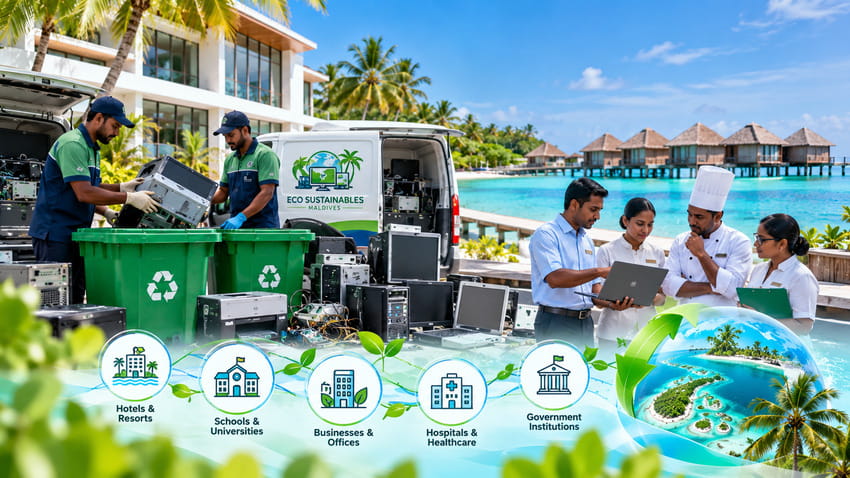
How Hotels, Resorts, Schools and Businesses Can
Why Organisations Need an E-Waste Management Plan
Electronic equipment is essential to modern organisations. Hotels rely on computers, networking equipment and communication systems. Resorts use office technology, security equipment and electronic controls. Schools depend on computers and digital learning devices, while hospitals use a wide range of electronic and diagnostic equipment.
As these assets age, they are repaired, replaced, upgraded or decommissioned. Without a clear management process, obsolete equipment can accumulate in storerooms, occupy valuable space or enter unsuitable disposal pathways.
An e-waste management programme gives an organisation a structured way to identify unwanted equipment, protect sensitive information, arrange collection and document its approach to responsible disposal.
For organisations operating across the Maldives, a planned approach can also help coordinate collection and transportation requirements between islands.
Step 1: Conduct an E-Waste Audit
Start by identifying the electronic equipment your organisation owns and the items that may soon become obsolete.
Your inventory may include:
-
Desktop computers, laptops and monitors
-
Printers, scanners and photocopiers
-
Phones, tablets and communication equipment
-
Network switches, routers and servers
-
Batteries, chargers and cables
-
Electronic appliances and specialised equipment
Record the item type, quantity, condition, location and whether it contains confidential information.
For large organisations, it may also be useful to record the department responsible for each asset and whether the equipment is suitable for repair, reuse or retirement.
An audit helps establish the likely volume of e-waste and makes collection planning more predictable.
Step 2: Establish an Internal Collection System
Employees should know where to place obsolete electronic equipment and whom to contact when devices need to be retired.
Designate a responsible staff member or department to coordinate e-waste activities. Depending on the organisation, this could be the facilities team, IT department, procurement unit or environmental and sustainability team.
Create a clearly identified collection area that is secure, dry and suitable for the equipment being stored.
Keep different categories of equipment identifiable, and arrange appropriate handling for batteries, damaged devices and specialised equipment.
Do not allow employees to dismantle electronics or remove components without an approved procedure.
Step 3: Protect Business and Customer Information
Data security is a particularly important consideration when disposing of IT equipment.
Computers, servers, phones and storage devices may contain customer records, employee information, financial documents, passwords or confidential business information.
Before equipment leaves the organisation:
-
Identify devices that contain data.
-
Back up information that must be retained.
-
Remove accounts and credentials where appropriate.
-
Apply an approved data-erasure or sanitisation process.
-
Arrange suitable destruction services if required by the organisation’s security policy.
-
Retain records of the actions taken.
A general e-waste collection arrangement should not be assumed to include certified data destruction unless this has been expressly agreed.
Organisations with specific confidentiality, contractual or regulatory obligations should ensure that their disposal process meets those obligations.
Step 4: Select an Appropriate Collection and Management Provider
Choosing a suitable provider is an important part of an effective programme.
Before engaging a provider, consider the following questions:
-
Can the provider accommodate the types and quantities of equipment involved?
-
What collection and transportation arrangements are available for your island?
-
How are equipment and materials identified, sorted and prepared?
-
What downstream treatment or recycling pathway will be used?
-
Are relevant registrations, licences, permits and approvals in place for the activities concerned?
-
Can the provider supply collection records or other documentation?
-
How are sensitive devices and items requiring special handling managed?
For export-based recycling pathways, organisations should also consider applicable documentation, authorisations and receiving-country requirements.
The appropriate arrangement will depend on the equipment, quantities, collection location and applicable regulatory requirements.
Step 5: Plan for the Maldives’ Island Geography
An organisation operating from one location may be able to arrange periodic collections. A resort group, retail chain or institution with locations across several islands may need a coordinated programme.
Consider establishing a schedule that groups equipment by location and collection category.
Where practical, plan collections around asset replacement cycles, office relocations, school technology upgrades, resort refurbishments and scheduled maintenance.
Provide the collection provider with advance information about quantities, access restrictions, storage conditions and any special handling requirements.
For remote locations, agree on suitable arrangements before moving equipment. This helps avoid unnecessary transfers, delays and unsuitable temporary storage.
Step 6: Align the Programme with Applicable Requirements
Organisations should review their responsibilities under the applicable laws and regulations of the Republic of Maldives.
The Waste Management Act (Law No. 24/2022), as amended, forms part of the country’s waste-management framework. Depending on the activities involved, relevant requirements may concern waste handling, collection, transportation, storage, export or other aspects of management.
Requirements can vary according to the type of waste, the activity undertaken and the organisation’s role in the process. Businesses should confirm their specific obligations with the relevant Maldivian authorities and appropriately authorised service providers rather than assuming that one procedure applies to every type of electronic equipment.
Maintaining an internal policy, identifying responsible staff and retaining appropriate records can help an organisation manage its process more consistently.
Step 7: Measure and Report Progress
A well-managed e-waste programme should track more than the number of devices collected.
Depending on the organisation’s needs and the information available, useful indicators include:
-
Total weight or quantity of e-waste collected.
-
Number of collection events completed.
-
Departments or locations participating.
-
Equipment reused or refurbished, where verified.
-
Materials sent for documented recycling or recovery, where information is available.
-
Staff awareness activities completed.
-
Collection records and relevant downstream documentation received.
Avoid claiming that all collected equipment was recycled if the final treatment outcome has not been verified.
Reliable records help organisations evaluate progress, identify gaps and communicate sustainability activities more credibly.
Step 8: Engage Employees and Stakeholders
An e-waste programme works best when people understand how to participate.
Share clear instructions with employees, contractors and relevant departments. Explain which equipment should be separated, where it should be stored and whom to contact.
Schools and universities can organise awareness activities and collection drives. Hotels and resorts can include e-waste procedures in their facilities-management processes. Businesses can integrate equipment retirement into IT asset management and procurement policies.
Government institutions and NGOs can also consider coordinated collection programmes that bring together multiple departments or participating organisations.
Partner with ESMV
Eco Sustainables Maldives (Pvt) Ltd. (ESMV) aims to support a more structured approach to e-waste management in the Maldives by connecting households, communities, businesses and institutions with appropriate collection and downstream management pathways.
Businesses, resorts, hotels, schools, universities, hospitals and public institutions can contact ESMV to discuss potential collection programmes, institutional requirements and partnership opportunities.
A discussion can help establish the type and quantity of equipment involved, the collection locations, any data-security considerations and the practical requirements for onward management.
Make E-Waste Management Part of Your Sustainability Strategy
Responsible e-waste management is not simply a task to complete when old equipment accumulates. It can become part of an organisation’s wider approach to resource efficiency, environmental responsibility and operational planning.
With a clear inventory, secure storage, appropriate collection arrangements and reliable documentation, organisations can manage obsolete electronics more systematically.
Is your organisation ready to establish an e-waste management programme? Contact ESMV to explore collection and partnership opportunities in the Maldives.
